
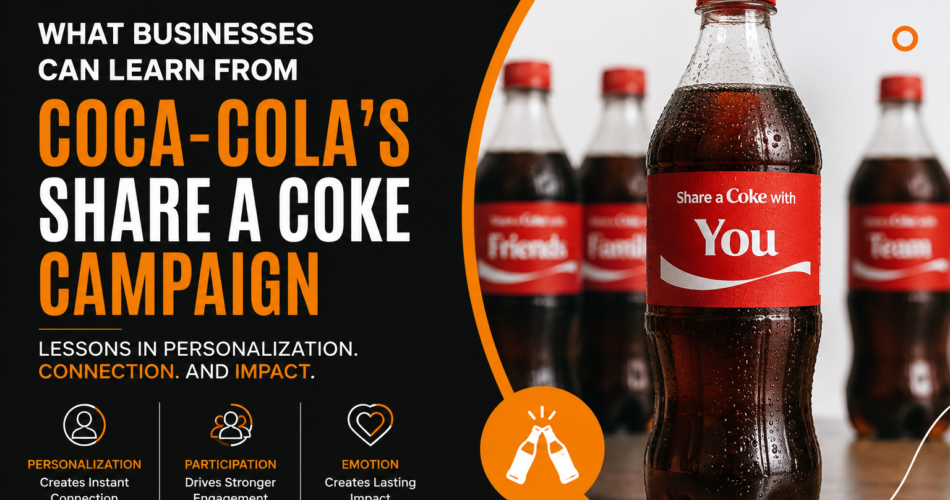
Imagine walking into a supermarket and suddenly spotting your own name on a Coca-Cola bottle.
You probably wouldn’t ignore it.
In fact, you’d likely pause, smile, and maybe even pick it up just out of curiosity.
That simple feeling of “This was made for me” is exactly what turned the Coca-Cola’s Share a Coke campaign into one of the most successful marketing campaigns in the world.
But here’s the interesting part:
Coca-Cola didn’t change the drink.
Instead, the company changed how people experienced the brand.
And that shift is what made millions of customers feel personally connected to something as simple as a soda bottle.
The Story Behind the Coca-Cola Share a Coke Campaign
The Coca-Cola Share a Coke campaign first started in Australia in 2011.
At the time, Coca-Cola wanted to reconnect with younger audiences who were no longer responding strongly to traditional advertising. Social media was growing fast, and people were spending more time engaging with experiences rather than ads.
So Coca-Cola decided to do something surprisingly simple.
The company replaced its iconic logo on bottles with popular first names.
Suddenly, shelves were filled with bottles that said things like “Sarah,” “Daniel,” or “Michael.” Almost immediately, people began searching for their own names and the names of friends and family members.
From there, things took off quickly.
Customers started sharing photos online, gifting bottles, and talking about the campaign naturally. What began as a small creative idea soon turned into a global viral marketing campaign.
Interestingly, Coca-Cola never changed the product itself.
The drink stayed exactly the same.
However, the experience around it changed completely.
And that made all the difference.
Now that we’ve looked at how the campaign started and why it worked, let’s slow down for a moment and talk about the key lessons that can actually be applied to businesses today.
Because beyond the creativity and global success, the real value of the Coca-Cola Share a Coke campaign is what it teaches us about customers, attention, and emotional connection in marketing.
So, here’s what businesses can take away from it.
Key Lesson #1: Personalization Creates Instant Connection
One of the biggest reasons the Coca-Cola Share a Coke campaign worked so well is personalization.
People naturally pay attention when something feels made for them. Seeing your own name on a product creates an immediate emotional reaction because it feels personal, even in a mass-produced world.
As a result, that small moment of recognition builds curiosity, excitement, and connection.
In today’s crowded digital space, where customers are constantly exposed to ads, personalization helps brands stand out more effectively.
For example, businesses can use a customer’s name in emails, offer personalized product recommendations, or send tailored offers based on behavior.
Over time, this makes customers feel seen, and that feeling builds stronger loyalty.
Key Lesson #2: Participation Creates Stronger Engagement
Another major reason the Coca-Cola Share a Coke campaign succeeded is participation.
Customers were not just watching the campaign — they were part of it.
They searched for bottles, shared photos online, tagged friends, and created conversations around the brand.
As a result, the campaign spread naturally through customer activity instead of relying only on advertising.
In today’s marketing, this is extremely powerful.
For example, businesses can encourage user-generated content, run contests, use branded hashtags, or feature customer stories across their platforms.
Over time, participation turns customers into active promoters of the brand.
And when customers take part in the experience, engagement becomes much stronger.
Key Lesson #3: Emotion Creates Stronger Impact Than Features
The Coca-Cola Share a Coke campaign worked so well because it focused on emotion.
It was not really about the product itself — it was about connection, identity, and shared moments.
As a result, the campaign felt more personal and memorable than traditional advertising.
In contrast, many businesses focus heavily on features when promoting their products or services.
However, features alone rarely create lasting emotional impact.
Instead, customers respond more strongly to how a product or service makes them feel.
For example, a fitness brand sells confidence, not just workouts. A skincare brand sells self-esteem, not just ingredients. A service business sells outcomes, not just features.
When businesses focus on emotional outcomes, their marketing becomes more powerful and relatable.
And as a result, customers are more likely to remember the brand long after the interaction.
Summary
The Coca-Cola Share a Coke campaign is still one of the best examples of how simple ideas can create massive impact when they connect with human emotion.
Coca-Cola didn’t reinvent its product.
Instead, it reinvented the customer experience around the product.
And in doing so, it created stronger brand engagement, deeper emotional connections, and a global conversation that people still remember today.
For businesses, the takeaway is clear:
If you want to stand out, don’t just focus on selling products.
Focus on creating experiences that feel personal, meaningful, and emotionally engaging.
Because at the end of the day, people may forget what you sold them — but they will never forget how your brand made them feel.
If this breakdown of the Coca-Cola Share a Coke campaign helped you, share it with someone who’s into marketing or building a brand — and tell us in the comment section: what’s one campaign you’ve seen that made you feel personally connected to a brand?

