
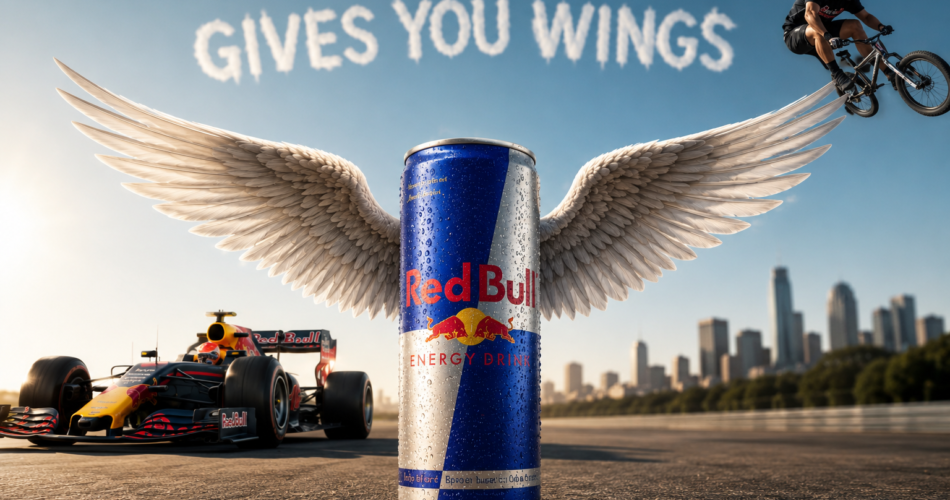
The brilliance of the Red Bull marketing strategy can be summed up in one unbelievable moment.
A man stood at the edge of space.
Not a movie.
Not a trailer.
Real life.
Felix Baumgartner was 128,000 feet above Earth, balanced on a tiny platform attached to a helium balloon, about to free-fall faster than the speed of sound.
Eight million people watched live on YouTube — at the time, the largest live stream in history. Newsrooms cleared their schedules. Phones lit up across continents. And stitched onto his suit, painted on his capsule, glowing in the corner of every screen, was a logo almost everyone recognized.
There’s no drink in sight, no “buy now” button, and no tagline shouting at you. Just a man, the stratosphere, and a brand quietly attaching itself to one of the most jaw-dropping moments of the decade.
That single jump captured something most marketers spend entire careers trying to understand: Red Bull was never really selling an energy drink. They were selling a feeling — and they figured out how to bottle it long before anyone else did.
They Sold Adrenaline, Not Caffeine
Walk down any beverage aisle and you’ll see the usual pitch: better ingredients, cleaner formulas, sharper flavors. Brands argue about milligrams of taurine like it’s a courtroom case.
Red Bull skipped the argument entirely.
Instead of telling people what energy is, they showed people what energy looks like.
Formula 1 cars carving through Monaco.
Snowboarders dropping off cliffs in Alaska.
Cliff divers in Mostar.
Mountain bikers descending impossible ridgelines in Utah.
Every campaign whispered the same idea without ever saying it out loud:
Energy isn’t a chemical. It’s a way of living.
Once that idea took hold, the drink became almost beside the point. You weren’t buying a can — you were buying into a worldview.
They Stopped Being a Beverage Company
Here’s the move most businesses miss.
Somewhere along the way, Red Bull made a quiet but radical decision: stop acting like a drinks brand and start acting like a media company. Red Bull built Red Bull Media House, a full-scale production studio that produces documentaries, magazines, original films, athlete profiles, and live event coverage that rivals major networks like ESPN.
Beyond media, the brand owns a Formula 1 team with multiple world championships and runs global competitions such as Red Bull Rampage and the Cliff Diving World Series. It also produced The Art of Flight, a visually stunning snowboarding film that was so impactful audiences paid to watch it in cinemas.
And here’s the trick: almost none of it feels like advertising.
People watch because it’s genuinely thrilling. They share it because it’s beautiful. They follow because it’s better than what most networks make. The product placement is so confident it barely needs to exist — the brand is the content.
That’s a level of trust no 30-second TV spot can buy.
They Built an Emotion You Can Recognize in a Split Second
Think about the strongest brands in the world. You don’t recall their product specs. You recall a feeling.
Apple feels like creativity. Nike feels like determination. Red Bull feels like adrenaline — fearlessness, speed, that small voice telling you to try the thing that scares you a little.
That kind of emotional shorthand takes years of discipline. Red Bull never wandered. Every sponsorship, every athlete, every event reinforced the same single identity: bold, fast, fearless, slightly insane. They didn’t chase trends. They didn’t pivot into wellness, or relaxation drinks, or whatever the marketing flavor of the year was instead they picked a lane in the 1990s and stayed in it for thirty years.
Consistency, repeated long enough, becomes identity.
The Real Lesson for Businesses
Most companies are trying to sell what they make. Red Bull figured out how to sell what they stand for — and the difference is enormous.
Here’s what any business, big or small, can pull from their playbook:
Sell the feeling, not the feature. Customers forget specs within hours. They remember how a brand made them feel for years. Decide what emotion you want to own, and protect it.
Create content people actually want. You don’t need a space jump. A small bakery can film the 5 a.m. dough rise. A consultant can publish the kind of teardown nobody else dares to write. The goal isn’t reach — it’s making something worth someone’s attention.
Pick one identity and stay there. Red Bull’s power comes from refusing to dilute itself. If you pivot your brand voice every quarter, no emotion ever gets a chance to stick.
Build the world around the product, not the product around the world. Red Bull built a universe of athletes, events, and stories. The can is the souvenir you take home from that world.
You Don’t Need a Stratosphere
Your business probably isn’t going to sponsor someone breaking the sound barrier in free fall. That’s fine. The principle scales down beautifully.
Ask the harder questions:
-
- What does your brand represent beyond what it sells?
-
- If your product disappeared tomorrow, would anyone still care about the story you tell?
-
- Are you interrupting people’s attention — or earning it?
The brands that outlast everyone else aren’t the loudest. They’re the ones that mean something specific to a specific kind of person. Red Bull means fearless. Patagonia means responsible. Lego means imagination. Each one picked a meaning and defended it for decades.
Conclusion
Red Bull didn’t dominate because of caffeine, taurine, or clever ingredient ratios. They dominated because they stopped competing in the beverage industry altogether and started competing in the attention industry — and once you’re playing that game, a can of energy drink is just the logo on the jacket of the guy jumping out of the sky.
The lesson isn’t “be extreme.” The lesson is this: people don’t fall in love with products. They fall in love with what products let them believe about themselves.
Build that, and you won’t need to chase customers anymore.
If you found Red Bull’s approach interesting, checkout our breakdown of how Coca-Cola built one of the most powerful marketing strategies in the world or comment the brand you would like us to talk about below.

